Generative AI vs. Human Creativity: A Creator's Guide for 2026
The debate over generative AI vs. human creativity isn't about replacement; it's about partnership, where AI amplifies speed while human taste provides irreplaceable meaning.
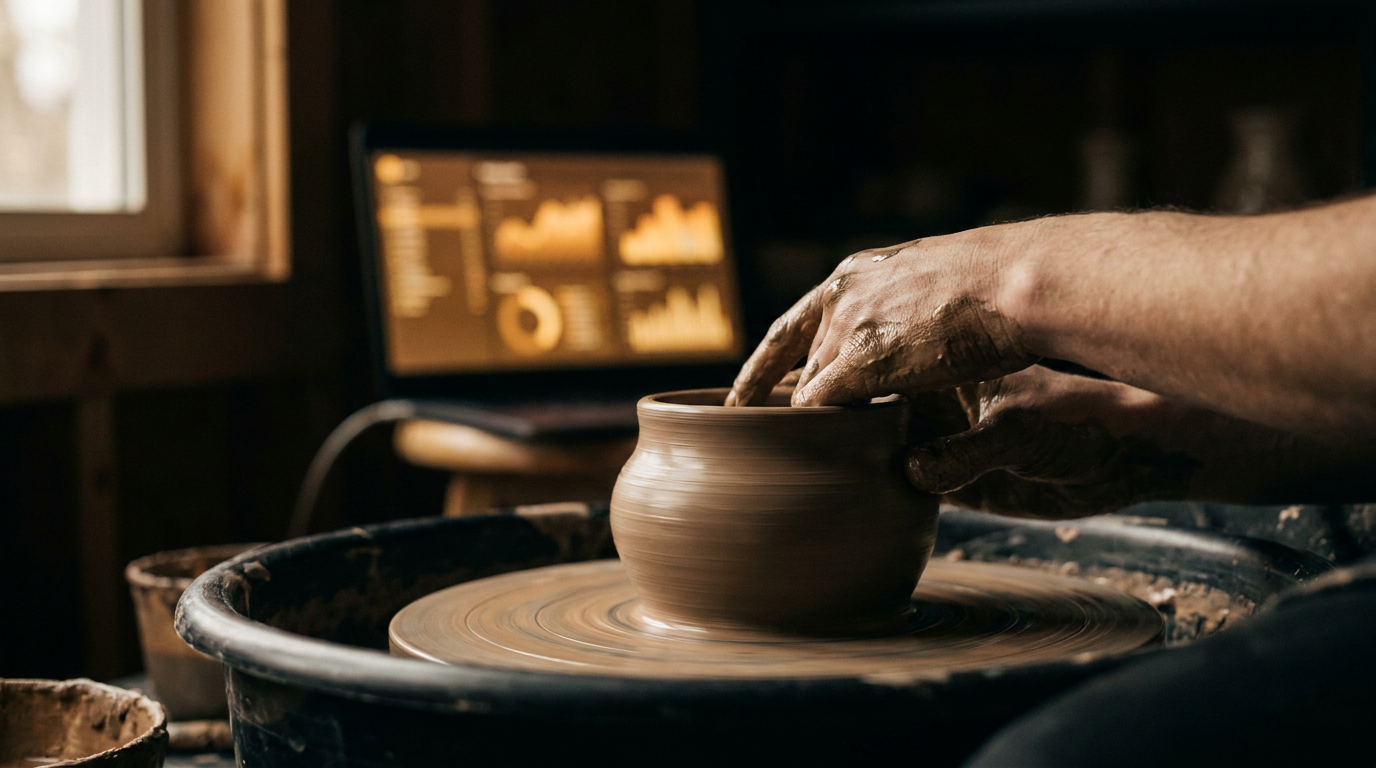
By now, in the late summer of 2026, the digital dust has settled. The initial shockwaves of generative AI—the frantic predictions of creative obsolescence, the awe at its emergent capabilities—have given way to a more pragmatic, and frankly, more interesting reality. The tools are no longer novelties; they are embedded in our workflows, humming quietly on our laptops like the world's most capable, if sometimes strangely literal, intern. The fiery discourse comparing generative AI vs. human creativity has moved from a theoretical battle for survival to a practical question of collaboration.
For writers, designers, musicians, and makers of all stripes, the question is no longer *if* we should use these tools, but *how*. How do we harness the astonishing speed and scale of machine ideation without sacrificing the soul of our work? How do we integrate AI-driven inspiration without our output becoming a generic echo of its training data? We are navigating a new creative landscape, and to do so effectively, we need a map that honors the unique strengths of both the human mind and its silicon counterpart.
This isn't another think piece on the end of art. It's a practical guide for the working creator in 2026. We will dissect the distinct advantages of each approach, offer a framework for a powerful hybrid workflow, and deliver a verdict on how to thrive in this new era. It’s time to move beyond fear and start building.
§What Are the Core Strengths of Generative AI in Creative Work?
The most celebrated strength of generative AI is its sheer velocity. It operates on a scale and speed that is fundamentally inhuman. Faced with the dreaded blank page, a writer can now generate a dozen starting points in seconds. A designer can visualize a hundred logo variations in minutes. This isn't just about efficiency; it's about radically lowering the activation energy required to begin. AI demolishes the initial friction that so often stalls a project before it even starts.
Beyond speed, AI offers unparalleled access to what complexity theorists call the 'adjacent possible.' Because its 'imagination' is a function of vast pattern-matching across billions of data points, it can surface unexpected connections and stylistic mashups that a single human mind might never conceive. It can offer you a sonnet in the style of a technical manual, or a visual aesthetic that blends Bauhaus architecture with baroque intricacy. While not truly 'original' in a human sense, this combinatorial power is a powerful catalyst for breaking out of familiar creative ruts and exploring genuinely novel pathways.
§Where Does Traditional Human Creativity Still Hold the Advantage?
For all its computational might, AI lacks a body, a biography, and a broken heart. Human creativity is inextricably linked to our lived, embodied experience. The nuance of a specific memory, the texture of a feeling, the vulnerability of sharing a personal failure—these are the raw materials of resonant art. AI can simulate emotion based on patterns in text and images, but it cannot authentically *feel*. It hasn't known love, grief, or the quiet joy of watching a sunrise. This deficit of experience is why purely AI-generated work often feels hollow, a technically perfect vessel devoid of any precious cargo.
“AI can mimic our styles, but it can't replicate our scars. And art without scars is just decoration. The human fingerprint isn't a flaw in the system; it's the entire point.”
This leads to the most crucial human advantage: taste. Taste is not just preference; it's a form of embodied intelligence, a deep, intuitive understanding of context, audience, and meaning. It's the ability to know that out of a hundred AI-generated options, this *one* is not just correct, but resonant. It's the judgment to take a promising but flawed AI idea and elevate it with a personal story or a contrary point of view. As AI commoditizes the act of generation, the uniquely human ability to curate, edit, and imbue work with intention becomes the ultimate differentiator.
§Generative AI vs Human Creativity: A Head-to-Head Comparison
To make an informed decision about how to structure your workflow, it helps to see the strengths and weaknesses of each approach laid out clearly. Neither is universally superior; their value depends entirely on the specific creative task at hand. Think of it not as a competition, but as a guide to assembling your ideal creative team, where one team member is human (you) and the other is a powerful, non-sentient algorithm.
| Creative Feature | Generative AI | Human Creativity |
|---|---|---|
| Speed of Ideation | Near-instantaneous; thousands of ideas per minute | Slow and deliberate; requires time for incubation |
| Originality Style | Combinatorial; remixes existing data in novel ways | Experiential; synthesizes lived experience into new insights |
| Emotional Depth | Simulated; pattern-matches emotional language | Authentic; drawn from genuine feeling and vulnerability |
| Scalability | Effectively infinite; no fatigue or burnout | Finite; limited by energy, time, and cognitive load |
| Taste & Judgment | Statistical; identifies common patterns as 'good' | Value-driven; applies personal ethics, taste, and context |
| Consistency | High; can replicate a style with perfect fidelity | Variable; influenced by mood, environment, and growth |
| Ethical Risk | High; potential for data bias, plagiarism, and IP issues | Low; governed by personal ethics and social norms |
§How Can You Build a Powerful 'Centaur' Workflow?
The most productive way forward is neither pure human Luddism nor total AI dependency. It lies in the hybrid model famously termed 'Centaur' thinking after chess grandmaster Garry Kasparov observed that a human player paired with a computer could beat both the best computer and the best human player. The human provides strategy, intuition, and purpose; the machine provides brute-force calculation and tactical exploration. For creators, this means becoming a 'Centaur Creator'.
Building this workflow requires a conscious shift in mindset. You must learn to see your creative process not as a single act of making, but as a series of distinct phases, some of which are better suited to machine speed and others to human depth. Here is a practical, four-step process to begin implementing this model in any creative project.
How to Integrate AI into Your Creative Process
- 1
Step 1: Divergence (The AI's Role)
Start with a broad prompt and use your AI tool to generate a high volume of disparate ideas. Ask it to explore wild premises, generate lists of metaphors, create stylistic variations, or outline twenty different structures for your story. The goal here is quantity and novelty, not quality.
- 2
Step 2: Convergence (The Human's Role)
This is where your taste comes in. Sift through the AI's raw output like a prospector panning for gold. Look for the glimmers of insight, the surprising connections, or the single compelling image that resonates with you. Your job is to select 1-3 promising directions from the hundreds generated.
- 3
Step 3: Refinement (The Human's Role)
Take the selected concepts and make them your own. Infuse them with a personal story. Contradict the premise with an unexpected twist. Rewrite the AI's clean prose to add your voice and cadence. This is the stage where you add the 'scars'—the vulnerability and specificity that transform a generic idea into meaningful art.
- 4
Step 4: Amplification (The AI's Role)
Once your core creative idea is solidified, you can bring the AI back in for production and polishing tasks. Use it to check for grammar, format text, generate placeholder images, write social media copy to promote the piece, or even create background music. This frees up your human energy for the next strategic creative decision.
§The Verdict: Is AI an Assistant, a Collaborator, or a Replacement?
So, returning to our central question of generative AI vs. human creativity, what is the final judgment? AI, in 2026, is best understood as a spectrum. At its most basic level, it is an unbelievably powerful assistant, automating tedious tasks and accelerating production. With more sophisticated prompting and a collaborative mindset, it becomes a true collaborator, a tireless sparring partner that can push your thinking in new directions.
It is not, however, a replacement. What we are seeing is not the replacement of the artist, but the evolution of the artist's role. The value of creativity is shifting away from the manual labor of generation and toward the higher-order skills of vision, curation, taste, and direction. The modern creator is becoming less of a solitary craftsperson and more of a creative director of a team of one human and an army of algorithms.
Ultimately, the quality of your work will not be determined by whether you use AI, but by the quality of the human spirit that guides it. An uninspired creator with an AI will produce a higher volume of uninspired work. A brilliant creator with an AI will amplify their brilliance to an unprecedented scale. The technology is a mirror; it reflects and magnifies the intent and taste of its user. The challenge, as always, is not to master the tool, but to master yourself.
§Frequently asked questions
Is using AI in art cheating?+
Will AI replace writers and artists?+
What are the best AI tools for writers in 2026?+
How do you maintain a unique voice when using AI?+
What are the pros and cons of AI art vs human art?+
What is human-in-the-loop creativity?+
Sources & further reading
- Public Attitudes Toward AI in the Creative Industries, 2025 — Pew Research Center (2025)
- The Economic Impact of Generative AI on the Creator Economy — McKinsey & Company (2024)
- Cognitive Synergies in Human-AI Creative Partnerships — Nature (2025)
- Leading Creative Teams in the Age of AI — Harvard Business Review (2024)
- Measuring Perceived Authenticity in AI-Generated and Human-Made Art — Journal of Creative Behavior (2026)
- Annual State of the Creator Report 2025 — The Creator Economy Institute (2025)
Featured Guides
How to Build a Strong Local Support Network After Moving to a New City
7 min read

7 Micro-Adventure Ideas for Busy Professionals to Break Routine and Reclaim Their Week
10 min read

Maya Hari's Quiet Confidence: Lessons from a Tech Leader's Rise
9 min read

Pomodoro vs Flow State: Structured Focus or Seamless Immersion?
9 min read